
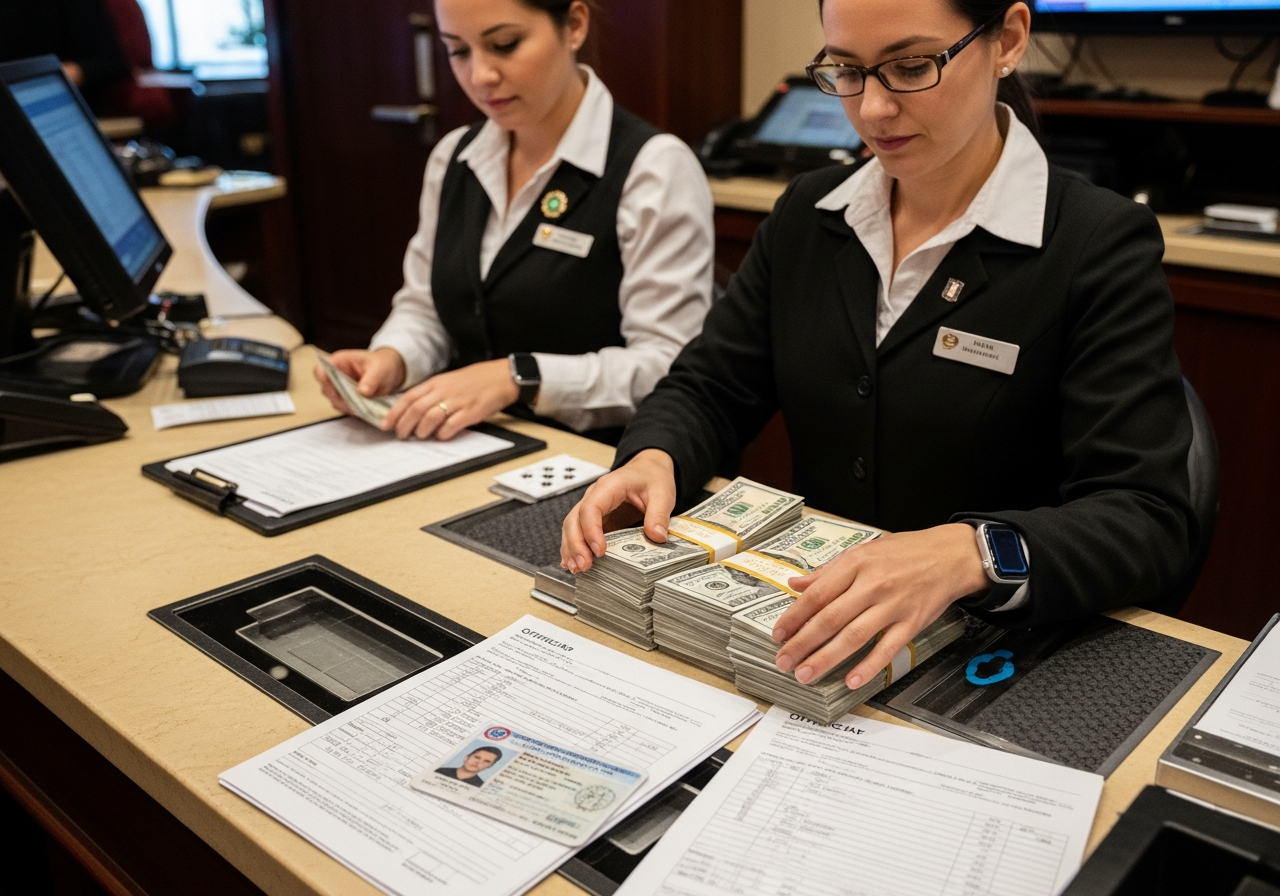
The slot machine bells chime as your screen lights up with a jackpot worth $12,000. As you approach the cashier’s cage with your ticket, the attendant congratulates you on your win but then asks for a photo ID before processing your payout. This scenario plays out thousands of times daily across US casinos, and it’s not just casino policy—it’s federal law.
When casino payouts exceed $10,000, the Bank Secrecy Act requires casinos to file a Currency Transaction Report (CTR) with the Financial Crimes Enforcement Network (FinCEN). This mandatory reporting mechanism helps prevent money laundering and tracks large cash movements through gaming establishments. While players have certain rights regarding ID requests below this threshold, attempting to structure transactions to avoid reporting can trigger serious federal investigations and penalties.
Federal Laws Mandating ID for Large Casino Payouts
The Bank Secrecy Act of 1970 established the foundation for all casino reporting requirements, mandating that financial institutions, including casinos, report cash transactions exceeding $10,000. This law treats casinos as financial institutions due to their high-volume cash operations and potential vulnerability to money laundering schemes. The $10,000 threshold applies to all cash transactions, including gaming payouts, and triggers automatic CTR filing requirements.
FinCEN, a division of the U.S. Treasury Department, oversees casino compliance with these reporting requirements and has the authority to impose substantial penalties for non-compliance. Casinos must maintain detailed records of all large transactions and submit CTRs within 15 days of the reportable event. These reports help federal agencies track suspicious financial activity and identify potential money laundering operations.
The reporting requirements extend beyond simple payouts to include any cash transaction that crosses the $10,000 threshold within a single gaming day. This comprehensive approach ensures that individuals cannot easily circumvent reporting requirements by splitting large transactions across multiple smaller amounts. Casinos must also aggregate related transactions to determine if the threshold has been met.
Modern casino surveillance systems and player tracking technology make it virtually impossible to avoid detection when conducting large cash transactions. The integration of these systems with compliance software ensures that all reportable transactions are captured and properly documented for federal reporting purposes.
What is a Currency Transaction Report (CTR)?
A Currency Transaction Report is a mandatory federal form that casinos must file whenever a customer conducts cash transactions totaling more than $10,000 in a single gaming day. The CTR captures essential information about the customer, including their name, address, Social Security number, and the nature of the transaction. This information helps federal agencies monitor large cash movements and identify potentially suspicious activity patterns.
The casino’s role in the CTR process involves verifying customer identity through photo identification, accurately recording transaction details, and submitting the completed form to FinCEN within the required timeframe. Casino compliance departments are responsible for training staff on proper CTR procedures and ensuring that all reportable transactions are captured without exception.
Filing a CTR is purely administrative and does not indicate wrongdoing by the customer or trigger any immediate law enforcement action. The information collected serves as a data point in larger financial intelligence gathering efforts designed to combat money laundering and other financial crimes.
When Does the $10,000 Threshold Apply?
Understanding when the $10,000 reporting threshold is triggered requires knowledge of how casinos track and aggregate transactions throughout a gaming day. The following situations all require CTR filing:
- Single payout exceeding $10,000 from slots, table games, or sports betting
- Multiple payouts to the same customer totaling more than $10,000 in one gaming day
- Combination of buy-ins and cash-outs that exceed $10,000 when aggregated
- Cash advances or credit transactions that cross the threshold
- Any cash exchange or redemption activity totaling more than $10,000
- Related transactions conducted by connected parties that collectively exceed the limit
The gaming day typically runs from midnight to midnight, though some casinos may use different 24-hour periods for tracking purposes. Player card activity, surveillance footage, and transaction records all contribute to accurate aggregation of customer activity throughout this period.
Casino Internal Policies Below the $10K Limit
While federal law only mandates ID collection for transactions exceeding $10,000, most casinos implement internal policies requiring identification at much lower thresholds. These policies typically kick in at $2,000 to $3,000 and serve multiple purposes beyond federal compliance. Internal tracking helps casinos monitor player behavior, prevent fraud, and maintain detailed records for their own security and marketing purposes.
Casino surveillance systems work in conjunction with these internal policies to create comprehensive customer profiles and transaction histories. This information proves valuable for identifying advantage players, preventing cheating, and understanding customer gambling patterns. The data collected also supports casino marketing efforts and helps identify high-value customers for comps and rewards programs.
These lower thresholds also prepare casino staff for proper procedures when larger transactions occur, ensuring smooth compliance with federal reporting requirements. Training staff to collect identification consistently at lower amounts reduces the likelihood of errors or missed reports when dealing with transactions that trigger federal requirements.
Why Casinos Ask for ID at $2,000–$3,000
Casino identification policies vary significantly across different regions and jurisdictions, with some locations implementing stricter requirements than others. The following comparison shows typical thresholds and reasoning across major gaming markets:
| Threshold | Reason | Legal Requirement? |
|---|---|---|
| $2,000 (Nevada) | Internal tracking and fraud prevention | No – Casino policy |
| $3,000 (California) | State gaming commission guidelines | Recommended practice |
| $2,500 (Atlantic City) | Customer verification and security | No – Internal policy |
| $1,500 (Tribal Casinos) | Enhanced compliance standards | Varies by compact |
| $5,000 (Riverboat Casinos) | State regulatory requirements | Yes – State law |
Las Vegas casinos tend to implement some of the strictest internal ID policies, often requesting identification for payouts as low as $1,200. This approach reflects the high-volume nature of Las Vegas gaming operations and the need to maintain detailed customer records for regulatory and business purposes. California card rooms typically follow state gaming commission recommendations that suggest ID collection at $3,000.
These regional variations reflect different regulatory environments and casino operational preferences. Tribal casinos operating under federal compacts may have unique requirements based on their agreements with state governments, while riverboat and commercial casinos must comply with specific state gaming regulations that may mandate lower ID thresholds than federal requirements.
Player Rights: Do You Have to Provide ID?
Players are not legally required to provide identification for casino transactions below the $10,000 federal threshold, despite casino requests for such information. This distinction between legal requirements and casino policies creates important protections for players who prefer to maintain privacy during smaller transactions. Understanding these rights helps players make informed decisions about when and how to interact with casino identification requests.
When players decline to provide identification for transactions below $10,000, casinos may implement alternative compliance measures including detailed written descriptions of the customer, surveillance photographs, or other identifying information. These alternative methods allow casinos to maintain internal records while respecting player privacy rights under federal law.
However, casinos retain the right to refuse service to customers who decline to provide identification, even for transactions below federal reporting thresholds. This business prerogative creates a practical balance between player rights and casino security needs, though most establishments prefer to accommodate customers whenever possible.
The relationship between player rights and casino policies becomes more complex when considering state-specific regulations and tribal gaming compacts. Some jurisdictions may have lower thresholds that carry legal requirements, making it important for players to understand local laws in addition to federal requirements.
Legal Obligations Under $10K
When declining to provide identification for transactions under $10,000, players and casinos should follow specific procedures to ensure compliance with applicable laws. The following steps outline the proper process:
- Casino staff should clearly explain whether the ID request stems from federal law or internal policy
- Players may politely decline to provide identification if the transaction is below federal thresholds
- Casinos must accept the refusal but may implement alternative identification methods
- Written descriptions or surveillance photographs may be taken for internal records
- The transaction should proceed unless state laws mandate identification at lower thresholds
These procedures help protect both player privacy rights and casino compliance obligations. Clear communication about the legal basis for ID requests prevents misunderstandings and ensures that all parties understand their rights and responsibilities.
What Casinos Do If You Refuse ID
When players exercise their right to refuse identification for transactions under $10,000, casinos typically implement alternative documentation methods to maintain internal compliance standards. Most establishments will create detailed written records describing the customer’s physical appearance, including height, weight, hair color, clothing, and any distinguishing features that could help identify them in future transactions.
Surveillance departments play a crucial role in this process by capturing clear photographs or video footage of customers who decline to provide identification. This visual documentation serves as a backup identification method and helps casinos maintain security records without violating customer privacy preferences. The footage is typically stored according to standard casino record-keeping policies.
Some casinos may also request alternative information such as a phone number or email address as a compromise measure when formal identification is declined. While players are not required to provide this information either, many find it to be an acceptable middle ground that satisfies casino record-keeping needs while maintaining privacy.
Risks of Structuring to Avoid Reporting
Structuring transactions to avoid federal reporting requirements represents one of the most serious compliance violations in casino operations, carrying severe criminal and civil penalties. The practice involves deliberately breaking down transactions that would exceed $10,000 into smaller amounts to evade CTR filing requirements. Federal agencies actively monitor for structuring patterns and have sophisticated tools for detecting suspicious transaction sequences.
FinCEN requires casinos to file Suspicious Activity Reports (SARs) when they detect potential structuring behavior, even if individual transactions remain below reporting thresholds. These reports trigger federal investigations that can result in money laundering charges, substantial fines, and potential imprisonment. The consequences of structuring far outweigh any perceived benefits of avoiding routine federal reporting.
Modern casino technology makes structuring detection increasingly sophisticated, with integrated systems tracking customer activity across multiple visits, locations, and transaction types. Player card usage, surveillance footage, and transaction timing all contribute to comprehensive monitoring that can identify structuring attempts across extended time periods.
| Action | Consequence | Reporting Type |
|---|---|---|
| Multiple $9,000 cash-outs in one day | Federal investigation, potential charges | SAR filing required |
| Splitting large bets across multiple sessions | Enhanced surveillance, possible ban | Internal tracking, SAR consideration |
| Using multiple casinos same day for payouts | Cross-casino monitoring alerts | Coordinated SAR filings |
| Recruiting others to conduct transactions | Money laundering conspiracy charges | Multiple SARs, law enforcement referral |
| Timing transactions across gaming days | Pattern recognition triggers investigation | SAR with detailed timeline |
| False identification to avoid aggregation | Identity fraud and structuring charges | Criminal referral, multiple reports |
Examples of Structuring Detection
Casino compliance systems employ sophisticated algorithms that analyze customer behavior patterns to identify potential structuring activities. These systems track daily transaction totals across all customer touchpoints, including slot play, table games, sports betting, and cage transactions. When a customer consistently approaches but does not exceed reporting thresholds, the system flags the account for additional review by compliance personnel.
Player card usage provides particularly valuable data for structuring detection, as it creates a comprehensive record of all customer activity regardless of transaction size or location within the casino. Customers who attempt to avoid detection by playing without their player card may still be identified through surveillance footage and facial recognition technology that links their activity across multiple visits. This interconnected monitoring makes successful structuring virtually impossible in modern casino environments.
Cross-casino communication networks allow gaming establishments to share information about suspicious customer behavior, creating an even broader detection network. When customers attempt to structure transactions across multiple properties, coordinated monitoring efforts can quickly identify these patterns and trigger appropriate reporting to federal authorities.
Acceptable Forms of Photo ID at Casinos
Casinos maintain strict standards for acceptable identification documents, requiring current, government-issued photo identification with clear images and readable text. These standards ensure accurate customer identification and support proper completion of federal reporting requirements when transactions exceed applicable thresholds.
The following forms of identification are universally accepted at US casinos for large transactions:
- Valid driver’s license from any US state or territory
- Current US passport or passport card
- State-issued identification card with photo
- Military identification with current expiration date
- Federal government identification cards
- Valid foreign passport with appropriate visa documentation
- Tribal identification cards from federally recognized tribes
State vs Federal Variations
Different types of identification may have varying acceptance policies depending on the casino’s location and regulatory environment. The following comparison shows typical acceptance standards across various ID types:
| ID Type | Accepted States | Notes |
|---|---|---|
| Enhanced Driver’s License | All states | REAL ID compliant preferred |
| Temporary Driver’s License | Limited acceptance | Must include photo and official seal |
| Foreign Passport | All jurisdictions | May require additional documentation |
| Tribal ID Cards | Varies by casino | Federal recognition required |
REAL ID compliant identification documents receive preferred treatment at most casinos due to their enhanced security features and federal compliance standards. These documents include additional security measures that make them more difficult to counterfeit and easier for casino staff to verify. Non-compliant licenses remain acceptable for casino transactions but may require additional verification steps.
International customers should be aware that foreign identification may require supplementary documentation such as visas or immigration papers to satisfy casino requirements. Some establishments maintain specific policies regarding international identification that may be more restrictive than federal requirements, particularly for high-value transactions.
Military personnel can typically use current military identification cards, though some casinos may prefer to see additional documentation if the military ID lacks certain security features or appears to be an older format. Retired military identification may not be accepted at all locations due to varying security standards.
What If Your ID is Expired?
Expired identification documents are universally rejected by US casinos for any transaction requiring identity verification, regardless of how recently the document expired. This strict policy stems from federal reporting requirements that mandate current, valid identification for all CTR filings and related compliance documentation. Casinos cannot accept expired documents even if they appear authentic and contain accurate customer information.
Customers with expired identification must obtain current documentation before conducting any transaction that requires identity verification. This may involve visiting a DMV for license renewal, applying for a passport replacement, or obtaining a temporary identification document with photo from appropriate government agencies. Some states offer expedited identification services that can provide temporary documents more quickly than standard renewal processes.
Tax and Reporting Implications for Winners
Understanding the relationship between casino reporting requirements and tax obligations helps winners navigate both federal compliance and their personal tax responsibilities. While CTRs track large cash transactions for money laundering prevention, they do not automatically trigger tax withholding or create immediate tax liabilities for recipients. Tax reporting follows separate rules with different thresholds and requirements.
The key distinction lies between transaction reporting for compliance purposes and income reporting for tax purposes. CTRs serve regulatory functions under the Bank Secrecy Act, while tax forms like W-2G address income reporting under Internal Revenue Service regulations. These parallel systems sometimes overlap but serve fundamentally different purposes in federal oversight.
Casino winners remain responsible for reporting all gambling income regardless of whether they receive tax forms from the casino. This includes winnings below tax withholding thresholds that may not generate formal tax documentation but still constitute taxable income under federal law.
Pending regulatory updates may modify some reporting thresholds and procedures, making it important for frequent casino customers to stay informed about current requirements. The integration of digital payment systems and cryptocurrency transactions may also create new reporting categories in future regulatory frameworks.
| Payout Amount | ID Required | Form Filed | Tax Impact |
|---|---|---|---|
| Under $1,200 slots | No (federal law) | None required | Self-reported income |
| $1,200+ slots | Yes | W-2G tax form | Automatic tax withholding |
| $5,000+ poker tournament | Yes | W-2G tax form | Potential withholding |
| $10,000+ any source | Yes (mandatory) | CTR compliance form | No automatic tax impact |
| $15,000 sports betting | Yes (mandatory) | CTR + W-2G | Both compliance and tax reporting |
CTR vs Tax Forms
Currency Transaction Reports serve exclusively as compliance tools for money laundering prevention and do not create tax withholding obligations or directly impact a winner’s tax liability. The CTR filing process focuses on transaction documentation rather than income calculation, and the information collected goes to FinCEN rather than the Internal Revenue Service. Winners should understand that CTR filing does not constitute tax reporting and does not satisfy their obligations to report gambling income on their tax returns.
Tax forms like W-2G operate under separate thresholds and serve different purposes in federal oversight. While a $15,000 slot machine jackpot would trigger both CTR filing for compliance purposes and W-2G issuance for tax purposes, the two forms serve distinct regulatory functions. The W-2G documents taxable income and may trigger automatic withholding, while the CTR simply records the large cash transaction for anti-money laundering purposes.
Casino compliance departments maintain separate systems for tracking tax reporting obligations and money laundering prevention requirements, though both systems may collect similar customer information. This dual tracking ensures that casinos meet all federal obligations while providing customers with accurate documentation for their tax preparation needs. Understanding these distinctions helps winners properly handle their tax responsibilities and compliance obligations.